What the Blue Hole Remembers
A near-perfect circle of deep water off Belize's coast is really a drowned cave system — and its floor holds a layered record of the planet's last four ice ages.
- Category
- Nature
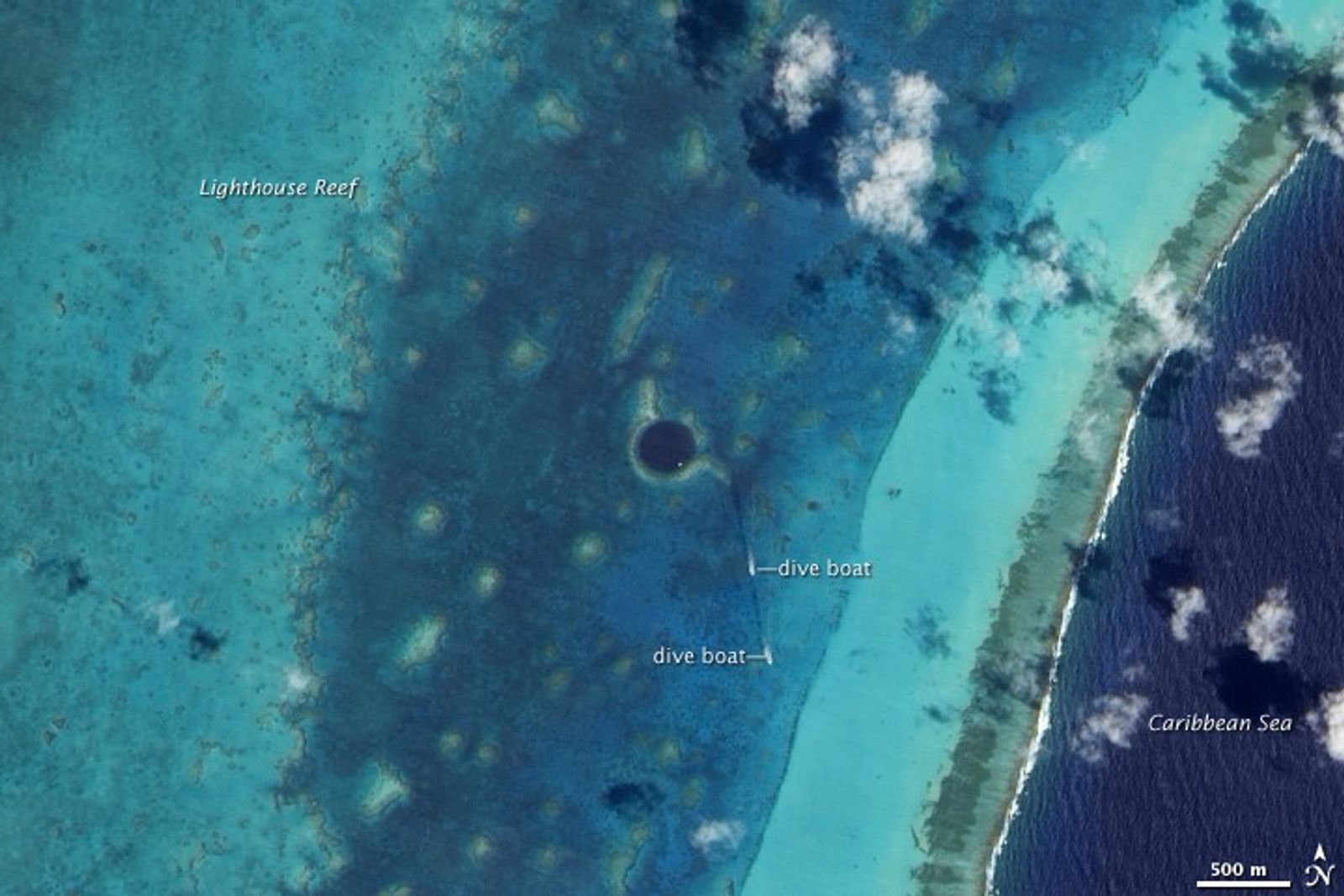
From above — from an airplane window, or from the International Space Station, where it has been photographed on more than one pass — the Great Blue Hole looks almost too regular to be natural: a near-perfect dark circle, 318 meters across, set inside the pale turquoise shallows of Lighthouse Reef, an atoll about 70 kilometers off the coast of Belize. The color contrast is the whole story in miniature. The surrounding reef is bright because light is bouncing off sand and coral in a few meters of water. The hole is dark because the water inside it is 124 meters deep — deeper than the reef flat around it by more than a hundred meters, dropping away almost like a shaft.
That is, in fact, more or less what it is.
A Cave, Not a Hole
The Great Blue Hole is not a hole in the sense of an impact crater or a blowhole. It is a karst formation — a limestone cave system, of the kind found on land throughout the Caribbean and the American South, that has been flooded by the sea. During the ice ages of the Pleistocene, when so much of the planet's water was locked into glaciers that global sea level sat dozens of meters below where it stands today, this stretch of Belizean limestone was dry land. Rainwater did what it does to limestone everywhere: it dissolved the rock along cracks and bedding planes, hollowing out caverns and letting mineral-rich water drip from their ceilings to build stalactites, the same slow process that decorates cave systems from Kentucky to Slovenia.
At some point, the cave's roof gave way, opening a vertical shaft to the surface. Then the ice ages ended. Sea levels rose by roughly 120 meters over thousands of years, and somewhere in that process — researchers generally place the final flooding in the range of 10,000 to 15,000 years ago — the ocean reclaimed the cave, drowning the chamber and leaving only its collapsed opening visible as the near-circular hole seen today.
The evidence for this history is written into the walls. When the French oceanographer Jacques Cousteau brought his research vessel Calypso to the site in 1971 — an expedition later featured on his television series — his team surveyed the interior and found distinct ledges at depths of about 21, 49, and 91 meters, terraces marking earlier, temporarily stable sea levels during the long flooding process. They also recovered stalactites from well below the current waterline, proof that these formations could only have grown in dry air, not underwater. Later analysis of those and other stalactites has identified at least four separate periods of cave growth — dated to roughly 153,000, 66,000, 60,000, and 15,000 years ago — corresponding to glacial cycles when sea level repeatedly dropped and rose again. Some recovered stalactites were found tilted about five degrees off vertical, which researchers interpret as evidence that the limestone plateau beneath the reef has shifted slightly since they formed.
What's Down There Now
The upper reaches of the Blue Hole are a genuine dive destination — regularly ranked among the world's best, and the reason Cousteau put it on the map for recreational divers as well as scientists. Down to about 30–40 meters, divers pass overhanging limestone shelves and can swim beneath giant stalactite formations, an experience unlike almost anywhere else in open ocean diving, precisely because it is not really an ocean floor at all but a cave interior.
Marine life directly inside the hole is sparser than the surrounding reef, since the depth and steep walls limit the sunlight and coral growth that support a dense reef ecosystem — divers commonly report Caribbean reef sharks, nurse sharks, and occasionally hammerhead or blacktip sharks passing through, along with midnight parrotfish and other reef species near the rim, but the interior itself thins out quickly with depth. Below roughly 90 meters, conditions turn hostile to life entirely. A 2018 expedition — using manned submersibles and backed in part by Richard Branson and Fabien Cousteau, Jacques Cousteau's grandson — mapped a layer of hydrogen sulfide beginning around 91 meters down, below which the water is anoxic, deprived of oxygen and essentially unable to sustain higher organisms. The same expedition located the remains of divers who had gone missing in the hole in previous years, and produced detailed sonar maps of the cave's full interior structure for the first time.
Part of a Larger, Fragile System
The Blue Hole sits within the Belize Barrier Reef Reserve System, a UNESCO World Heritage Site that protects the second-largest barrier reef in the world, after Australia's Great Barrier Reef. UNESCO placed the reserve on its List of World Heritage in Danger in 2009, citing threats from offshore oil exploration, mangrove clearing, and unregulated coastal development. Belize's government responded with a moratorium on offshore oil drilling and stronger mangrove protections, and in June 2018 UNESCO's World Heritage Committee formally removed the reef system from the danger list — one of the rarer conservation reversals of its kind.
The Blue Hole itself has no permanent structures and supports no fishing industry; its value, both to Belize's tourism economy and to the geologists who still study it, is almost entirely in what it preserves: a vertical timeline of the Ice Age written in stone, sealed under water, in a shape regular enough to be mistaken, from orbit, for something built rather than something that simply happened.

Sources
Continue exploring

The Ghost Fleet of Truk Lagoon
In a single winter morning in 1944, American carrier aircraft sank an entire Japanese fleet at anchor — and left the Pacific's most haunting time capsule on the seafloor.